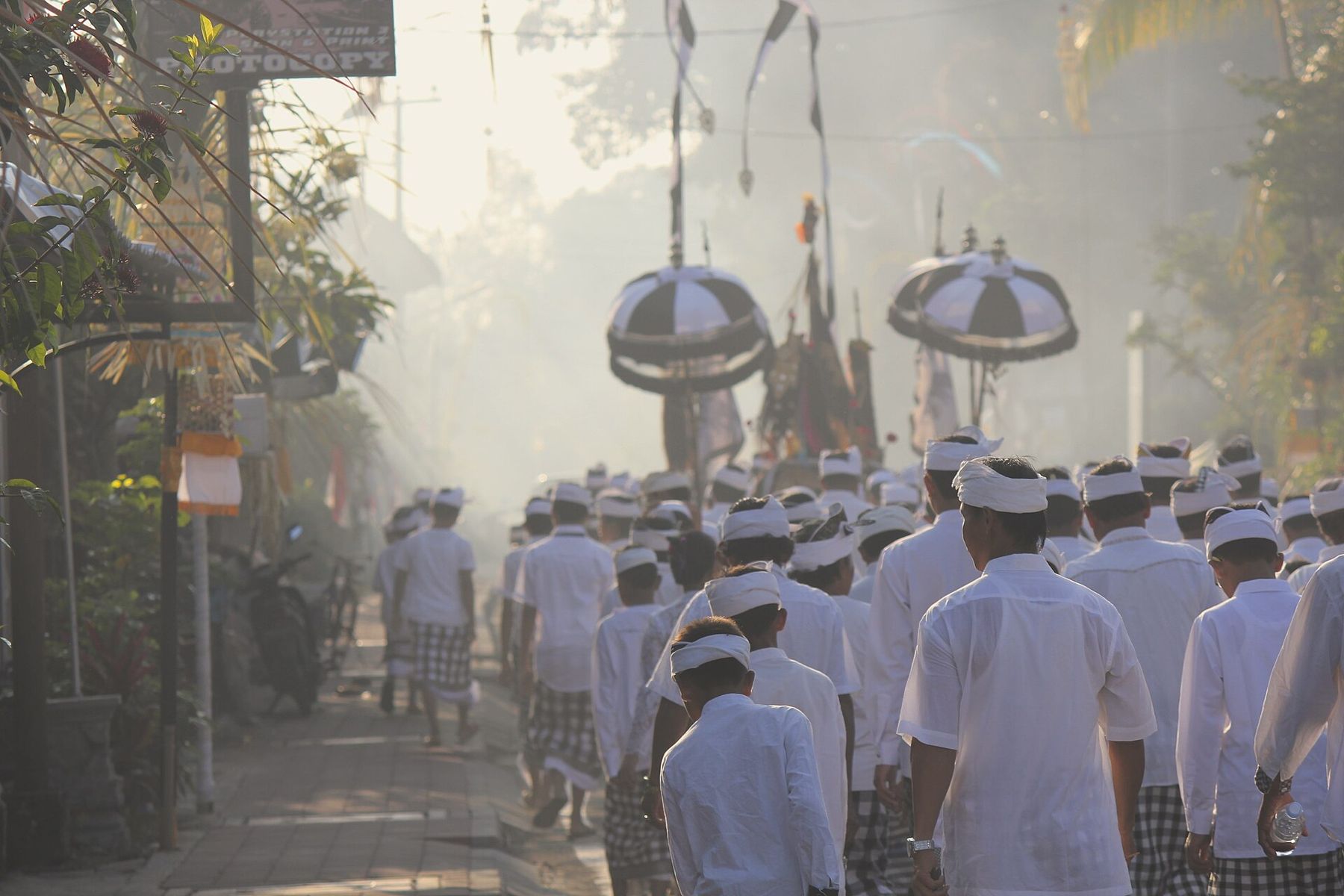
You notice the penjor first. In the days before Galungan, tall bamboo poles appear outside every Balinese home, their tips curving out over the road and hung with woven palm leaf. Drive through a village and they arch above you in a long green and gold avenue. They are the outward sign of Bali's most important recurring festival.
What Galungan celebrates
Galungan marks the victory of dharma, the good and right order of things, over adharma, its opposite. It is also the time when the spirits of the ancestors are believed to return to their family homes. Families prepare offerings to welcome them, pray at the house temple and at village temples, and spend time together.
The festival follows the Balinese pawukon calendar, a cycle of 210 days, so it comes round roughly every seven months and can fall in any season. It always lands on a Wednesday. Ten days later comes Kuningan, when the ancestral spirits depart. The time between them is one of the most festive periods of the Balinese year.
The days of preparation
Galungan does not arrive suddenly. In the days before, families ripen bananas, make rice cakes and prepare piles of offerings. The day before is Penampahan Galungan, when pigs are slaughtered for the feast and kitchens are busy with spiced dishes such as lawar and satay. The air smells of smoke, coconut and spice.
The penjor go up on that day too. Everyone is working, and the mood in the villages is cheerful and purposeful. Markets are crowded with people buying flowers, palm leaf, fruit and cloth, and roadside stalls sell ready-made decorations for families short of time. Young men climb ladders to fix the heavy poles in place, and neighbours step back to judge whose penjor curves most gracefully.
Inside the family compounds, the work is quieter and just as careful. Offerings are built up in layers on trays, cakes are stacked into tall towers, and the house temple is cleaned and dressed with cloth and umbrellas. If you are staying with a Balinese family, or close to one, you may be invited to watch or even help with a simple task. Accept with thanks, follow instructions closely, and do not be shy about asking what something means.
The penjor
A penjor is a long bamboo pole, curved at the tip, decorated with young coconut leaf, rice, fruit, cakes, cloth and other gifts of the land. At its base stands a small bamboo shrine for offerings. The curving shape is often likened to a mountain, and to Mount Agung in particular, and the penjor as a whole expresses gratitude for the earth's abundance.
Each family makes or buys its own, and some villages put great effort into them, so the lanes become a display of craft. Penjor remain standing for several weeks after Galungan before they are taken down.
Treat them with care. Do not pull on the decorations, lean against the poles or move the offerings at their base for a photograph.
 Another courseNyepi, the day of silence
Galungan day and after
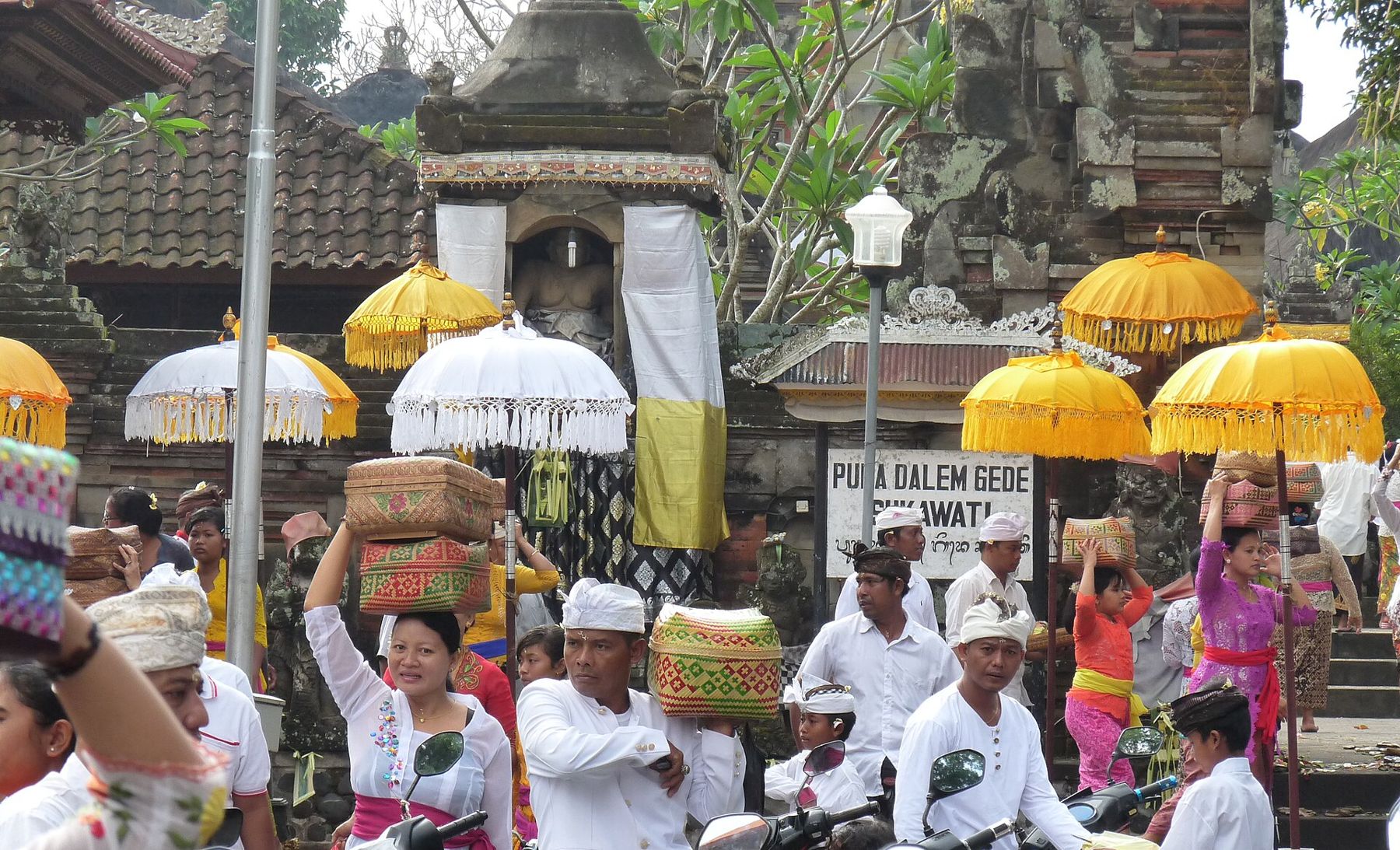
On Galungan itself, families dress in their finest temple clothes and carry tall arrangements of fruit and cakes on their heads to the temples. Worshippers often visit their family temple first, then the village temples. The day after, Manis Galungan, is a time for visiting relatives and friends, and for outings.
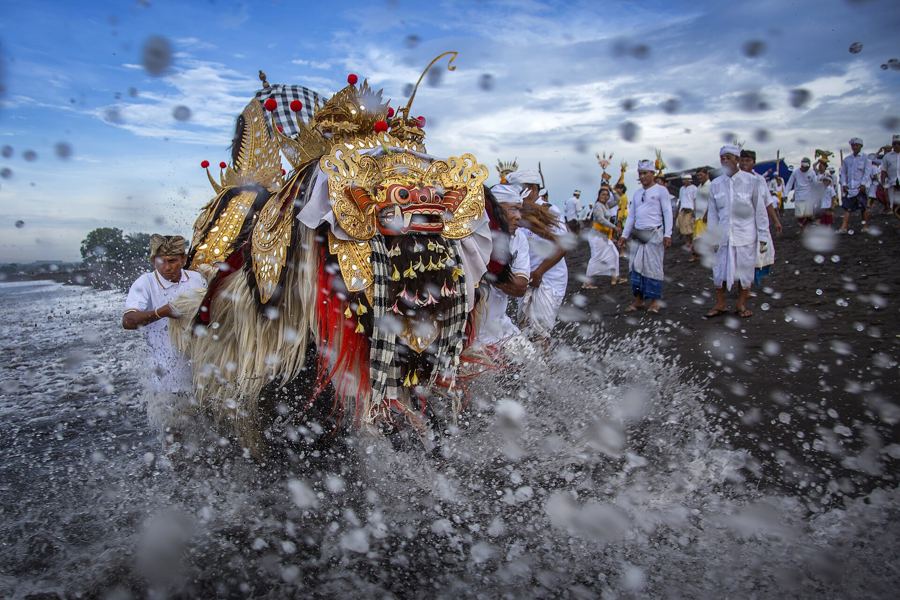
During the days between Galungan and Kuningan you may see barong ngelawang, when a barong, the lion-like protector figure, is taken from house to house in some villages with gamelan music, to bring blessings and drive away harm. Children often follow it in a cheerful crowd. If it stops near you, stand aside to let it pass, and if a family offers a small donation to the performers, you may do the same.
On Kuningan, ten days after Galungan, offerings include yellow rice, and special woven decorations appear in the temples. Ceremonies on Kuningan are traditionally completed by around midday.
What visitors see and how to behave
For visitors, Galungan is a fine time to be in Bali. The villages look their most beautiful and the streets are full of people in ceremonial dress. You are welcome to watch, but this is a religious festival and a family occasion, not a performance.
- Watch processions from the side of the road, without walking through them.
- Wear a sarong and sash, and cover your shoulders, if you enter a temple.
- Do not step over or on offerings; walk around them.
- Ask before photographing people at prayer, and never use flash.
- Expect some places to close, and plan for slower roads as families travel.
If you are unsure how to dress or act at a temple, the guide to temple etiquette and what to wear covers the basics, and the piece on the subak and its water temples explains the temples that serve the rice fields.
Planning around it
Because the pawukon cycle is 210 days, Galungan dates are easy to find for years ahead. Check them before you travel if you want to see the festival, or if you need to plan around closures and travel by local families. Schools close and many Balinese take time off, so roads to home villages can be busy.
Ceremonies happen in Bali all year, and Nyepi, the day of silence, is a different and quieter festival; the guide to Nyepi explains how it works. But for colour and warmth, nothing quite matches a village lane lined with penjor on the morning of Galungan.
The people who took these pictures are thanked by name, with their licences, in Photographs and thanks.